Organisation
You are currently viewing a placeholder content from Default. To access the actual content, click the button below. Please note that doing so will share data with third-party providers.
More InformationFree work
Children want to learn. Every child learns differently. School is successful when every child can become active according to his or her interests and learning level. This is exactly the core of free work.
In this form of teaching, the child chooses its own working topic and material, the time for a particular task and the partner. Material presentations by the teachers, individual learning status discussions and workbooks give the child orientation. The child’s freedom ensures that he or she is neither overwhelmed nor bored in class, but works with maximum concentration. The structures ensure that all topics of the Berlin framework curriculum for primary school are covered in class. Therefore, free work does justice to the child and leads to better results.
Free work takes up the largest part of the lessons at our school. It includes at least the subjects German, mathematics and science (or from grade 5 onwards social studies and science). Every teaching day begins with this.
Material
Learning needs stimulation. For the learning areas of language, mathematics and cosmic education, Maria Montessori has developed material that stimulates children, supports their imagination, and promotes their own learning and practice. It is the most important working tool for our lessons.
The Montessori material is usually made of wood. It is aesthetic and invites work. It makes mathematics, language and the world literally “graspable”. The colours and shapes are designed in such a way that children can recognise certain meanings. Exercises are used for repetition. The child can use the material to check the results of his or her own work. This supports the ability to assess their own learning progress.
Each classroom is fully equipped with these materials – age-appropriate and according to the international standards of the Association Montessori Internationale. In the older grades, the Montessori material is supplemented by tablets and other digital devices used according to the same principles.
Learning groups
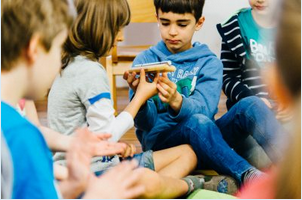
Learning needs others. In mixed-age groups, children from grades 1-3 and 4-6 learn together with us. This has many advantages: Younger and older pupils support each other, bring different experiences into the group and look out for each other. We encourage learning from and with each other. When needed, each child finds a caregiver who can give them a sense of security and orientation. On other occasions, they can take on this responsibility themselves. Pupils in mixed-age learning groups learn social competence in this way. Professional learning is also supported when children learn from children or deepen what they have already learned by explaining it to others.
Our class sizes are based on our rooms. They are slightly below the class sizes at public primary schools in Berlin. With often 21-25 children, the classes are large enough for each child to find friends of the same age. We ensure a particularly good supervision ratio by usually having two educational specialists in each class at the same time.
The Earth’s Childrens Programme
From Year 7 onwards, we put Maria Montessori’s Earth Children’s Programme into practice in a very hands-on way. At this stage of their development, young people need not only knowledge, but also real-life tasks, responsibility and the experience of being able to make a difference through their work. That is why we combine subject-based teaching with practical work, project-based learning and learning outside the school. In our school’s educational approach, this form of project work is closely linked to WAT (Economics, Work and Technology) and careers guidance.
An important learning venue in this context is the Domäne Dahlem. Here, our pupils can directly experience and explore topics such as agriculture and food, sustainability, the circular economy, craftsmanship, natural sciences and economic activity. Not only theoretical insights, but also, for example, practical fieldwork and the use of the teaching kitchen, workshops or the apiary are important components of our collaborative work.
These experiences are built upon in WAT lessons: the young people plan, produce, calculate, document and reflect. They explore consumption and work, develop their own products and learn to weigh up economic, environmental and social decisions.
In this way, learning does not take place solely in the classroom. The world itself becomes a place of learning. Young people experience a sense of self-efficacy, take responsibility for themselves and the community, and discover their own interests and abilities. At the same time, they gain their first authentic insights into the world of work, career fields and entrepreneurship.
Feedback and evaluation
Learning needs feedback. This works better without grades. That is why we only give grades where it is necessary for a successful choice of secondary school, i.e. on the report cards for grades 5 and 6.
We reject a learning culture characterised by pressure to perform, learning for the test and selection of “good and bad students”. We use assessment with grades neither as a means of reward nor as a means of pressure.
All the more diverse are our means for individual feedback on the learning status to the children and parents:
- Montessori developmental material – gives the child direct feedback on the task worked on
- Class community – we train an appreciative, open feedback and error culture
- Pensenbuch – overview of the “workload” of learning, i.e. the contents of the Berlin framework curriculum, with continuous, written documentation of personal learning progress
- Evaluation and report card discussions – held every six months between pupil, parents and class teacher.
- Certificate with verbal evaluation
As a state-recognised primary school, we also award numerical grades with the reports for grades 5 and 6 and issue a promotion prognosis at the half-year mark of grade 6. This puts our pupils on an equal footing with the graduates of all state primary schools in Berlin when it comes to applying for secondary school.
The path to a school-leaving certificate
As a comprehensive school, we prepare our pupils for a range of school-leaving qualifications and keep their educational pathways open for as long as possible.
Many young people aim to take the Abitur. We provide targeted preparation for this too. That is why all our pupils learn Spanish as a second foreign language from Year 7 onwards.
The integrated educational pathway enables young people to find their own direction in line with their individual development and to work step by step towards the qualification that suits them best.
School concept
Our educational team has laid down in the school concept how we work at the International Montessori School Berlin. You can find the concept here.

Alexander Delport Headmaster International Montessorischool Berlin
At IMS, our Montessori teachers create the framework for releasing potential for individual and collective learning processes.
The next Information Evening will take place on:
Tuesday, 17 November 2026 | 06:00 p.m.
(in English and German)
________________________________________________
The next Online-Information Evening will take place on:
Tuesday, 15 December 2026 | 05:30 p.m.
(in English and German)
________________________________________________
Please contact
- for the IMS: Frau Schöttler by email at:
ims.verwaltung@montessori-friends.de - for the Nursery email to
kita@montessori-friends.de
We look forward to seeing you then!